

Not a dramatic weekend disaster, not a prime-time spectacle—just a quiet, inconvenient Tuesday. Most of the world never even saw it; by the time social media caught on, the fire streak across the sky had already vanished beyond the jungle horizon.
By the time anyone realized it hadn’t burned up, it was already buried.
Dr. Maya Herrera watched the replay on a tablet as the helicopter rattled toward the crash site. Someone had stabilized phone footage, added a slow-motion slider, and circled the object with a neon-red ring.
“It doesn’t break apart,” she murmured. “Not even at peak heating.”
Beside her, Commander Erik Lang of the Brazilian Air Force leaned closer. “No fragmentation. That’s what caught our attention. That, and the thermal readings when it hit.”
“How big?” she asked.
“About the size of a car.” He paused. “But the impact crater is… off.”
“You’re going to have to be more specific,” Maya said.
“You’re the planetary scientist,” he replied, eyes on the jungle beyond the window. “You can tell me.”
The crash site sat at the edge of an uninhabited stretch of rainforest, a place too remote even for illegal logging. From above, Maya saw the scar before the pilot announced it: a dark, circular wound in the green, trees flattened outward in a perfect radial pattern.
“Looks like an impact,” she said.
“Look closer,” Lang told her.
The helicopter banked lower.
Maya frowned.
The trees weren’t burned. No blackened trunks, no ash plume. Instead, every leaf along the outer ring had turned a deep, vivid blue, like someone had inverted the color palette of the forest. They shimmered faintly, even under midday sun.
“What the hell…” she whispered.
They landed at the perimeter, where a growing cluster of military tents and research trailers huddled in uneasy companionship. The air felt heavier here, saturated with humidity and something else—an almost metallic sweetness that clung to the back of her throat.
Colonel Ferreira, the on-site commander, met them with a tablet in hand and two guards at his shoulders.
“Dr. Herrera,” he said, offering a quick nod. “Thank you for coming so quickly.”
“You said you’d found a meteorite with anomalous properties,” she said, skipping the small talk. “What kind of properties?”
The colonel hesitated, then handed her the tablet.
On the screen, a thermal image glowed in false color. The impact zone—roughly circular, fifty meters across—radiated steady warmth, not cooling over time like a normal strike. The hottest point wasn’t the crater floor.
It was the object still buried beneath it.
“Constant heat output,” Ferreira said. “No decay curve. We’d call it a reactor if it were man-made.”
“Any radiation?” Maya asked.
“Background only,” he said. “No spikes. No obvious danger.”
Obvious, she thought. That word did a lot of work.
“Show me,” she said.
The crater floor sloped gradually downward, coated in a fine layer of gray dust that clung to her boots like ash. But it wasn’t ash. Up close, the particles glittered faintly, as if each grain contained a tiny shard of glass.
“Impact ejecta?” Lang asked.
Maya knelt, scooping a handful into a collection vial. It was strangely light, softer than it looked, and faintly warm in her palm. She resisted the urge to brush it off on her pants and sealed the vial quickly.
“Or residue,” she said. “We won’t know until the lab work.”
The air inside the crater felt thick, almost viscous. Her breathing sounded louder in her ears. At the center, a temporary scaffold had been constructed over a circular depression where the object had punched into the soil.
Except there was no rock.
Instead, a dark, smooth surface bulged from the earth—matte black, faintly ridged, roughly oval. It reminded Maya of a polished seed pod from some gigantic tree.
“Not metal,” she said, touching the surface through her gloved fingertips. It yielded just a fraction, like dense rubber, then pushed back. Living tissue came to mind, and she immediately wished it hadn’t.
“Organic?” Lang asked.
“Don’t say that,” she muttered. “I’m still pretending it’s a very weird rock.”
As if hearing her, the object hummed.
It was low and soft, barely audible, more felt than heard—a vibration in her bones. The surface warmed under her hand.
“Did you feel that?” she asked.
Lang nodded slowly. “It reacted to your touch.”
Maya pulled her hand back. The warmth lingered in her skin.
“Has it done that before?” she asked the colonel.
“Only once,” Ferreira said. “When one of my men got too close with a drill. We decided to… pause mechanical intervention.”
“Probably wise.”
She circled the protrusion, keeping a deliberate distance now. The ridges ran lengthwise, converging at a pointed end that had penetrated the ground. The top was smooth, unblemished.
No cracks.
No visible entry points.
“Whatever it is,” she said, “it’s intact. The energy output suggests activity, but we need more data before we—”
The ground shuddered.
It wasn’t an earthquake. It was too localized. Dust rippled away from the object’s base. The black surface swelled subtly, as though something inside exhaled.
“Everybody back!” Lang shouted.
They scrambled up the slope as the object pulsed again. The air warmed by several degrees; sweat pricked Maya’s neck beneath her collar.
Fine fissures appeared along the ridges, thin as hair at first, then widening. A faint bluish light seeped from within, brightening with each heartbeat.
“Oh God,” Ferreira muttered. “Is it going to explode?”
“No,” Maya said quietly.
The word came unbidden, from somewhere beyond fear.
“It’s going to open.”
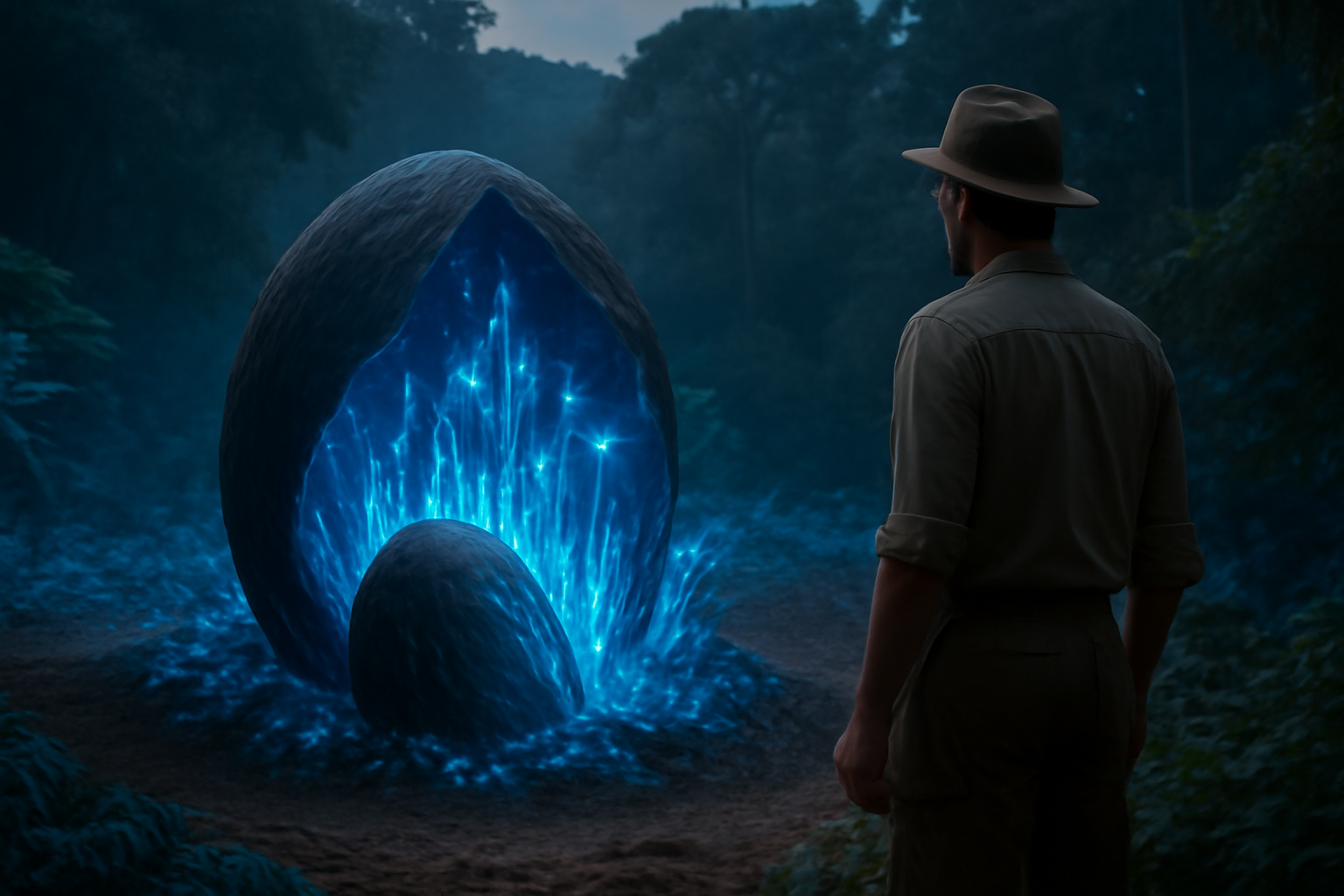
They watched from the crater rim as the object’s shell split along its seams, peeling back in overlapping segments like the petals of a night-blooming flower. The blue light inside washed across the crater, painting the dust and their boots in otherworldly hues.
The “petals” curled outward, revealing the core.
It wasn’t solid.
It was a cavity.
Inside the seed—she could no longer think of it as anything else—floated something like soil, a dark, rich substrate suspended in a matrix of faintly glowing filaments. Tiny motes drifted through it, gathering and separating in patterns that looked almost purposeful.
“Is that… water?” Lang asked.
Maya squinted. One of the filaments brightened, and a droplet formed at its tip, falling upward before dissolving into a miniature cloud that rained down in a fine mist.
“Not water as we know it,” she said. “But some kind of fluid cycle, yes.”
“You’re saying it’s… self-contained?” Ferreira’s voice shook. “Like a… tiny ecosystem?”
As they watched, a patch of the dark substrate swelled. Something sprouted—fast. Within seconds, a thin stalk emerged, branching into fractal limbs that twisted and unfurled, forming a lattice of delicate, translucent leaves. The leaves pulsed with blue light.
Then the stalk split, shedding a cloud of seedlike specks that drifted within the cavity before embedding themselves in other parts of the substrate.
Another sprout.
Another lattice.
Another.
Maya’s mind raced. “It’s not just an ecosystem,” she whispered. “It’s a template. A world in miniature.”
Within minutes, the once-empty core had become a tangled, glowing forest of structures that were not quite plants, not quite machines. Some formations resembled crystalline spires, others fractal webs. Tiny, wheeling sparks moved along the networks like insects made of light.
One of the structures leaned—no, oriented—toward the crater rim. The glow along its surface intensified.
Maya felt a prickling behind her eyes.
The seed was aware of them.
“Colonel,” she said slowly, “has the perimeter changed since the impact?”
He frowned. “What do you mean?”
“The trees,” she said. “The blue coloration. Has it spread?”
He tapped his radio, murmured a quick order. A few tense minutes later, a scout reported back.
“Yes, sir. The discoloration’s moved… maybe ten meters outward. Hard to tell exactly, but… yes. It’s expanding.”
“How fast?” she asked.
“At that rate… maybe a meter an hour,” the scout replied.
Maya’s stomach knotted. At a meter an hour, they had days at best before the entire valley transformed. Weeks before the seed’s influence reached the nearest village.
“What happens when this… thing reaches native plant life in force?” Lang asked quietly.
Maya looked at the miniature world inside the seed—the precise, controlled growth, the glowing network of structures, the tiny specks moving along them.
“It colonizes,” she said. “That’s what seeds do.”
They set up a mobile lab at the edge of the crater. Samples of the dust, the blue-tinted leaves, and even air from within the crater were catalogued and sealed for analysis.
The dust, under the microscope, writhed.
Not alive in any simple way, but responsive. When exposed to heat, the particles aligned into lattice formations. When cooled, they relaxed back into random scatter. When exposed to a drop of the fluid from the seed cavity, they grew filaments.
“Self-organizing,” Maya muttered. “This isn’t debris. It’s… substrate. Soil for whatever this seed wants to grow.”
The leaves from the transformed trees were worse. Their cells had been overwritten by something like crystal—no chlorophyll, no familiar internal structures. Instead, a network of microscopic nodes pulsed faintly, reacting to stimuli faster than any plant should.
When she waved her hand over the sample, the veins in the leaf aligned toward her movement, as if tracking.
A message blinked on her tablet; Ferreira had sent an updated map.
The bluened zone had advanced another twenty meters.
At the center, the seed’s internal world had grown denser. Structures twisted into larger networks. Some had begun to rotate around a central point, like a miniature planetary system within the cavity.
It wasn’t just an ecosystem.
It was an architecture.
“Commander,” she said, finding Lang outside the lab tent, “this is not a passive object. It’s active terraforming on a micro scale. The dust, the air, the vegetation—it’s all being rewritten.”
“Rewritten into what?”
“Into its own template,” she said. “Into itself. This isn’t a meteorite, Erik. It’s a seed meant to plant an entire alien environment wherever it lands.”
He stared at the crater, jaw tight. “So the question is: did it miss… or did it hit exactly where it was supposed to?”
Maya didn’t answer.
At midnight, the seed sang.
The sound rolled out from the crater like a low, crystalline chord, vibrating through tents and bones and teeth. Every electronic device within the perimeter flickered. Some died entirely.
Maya stumbled from her cot, heart hammering, as the night sky above the crater lit with a faint, blue aurora.
The seed’s inner structures had expanded to the edge of the cavity now, pressing against the open shell. Threads of light extended outward, probing the air, tasting it.
“What is it doing?” Lang shouted over the hum.
“Scaling,” Maya whispered. “It’s too big for the pod. It’s ready to… propagate.”
As if in response, a portion of the internal “forest” shed a cascade of luminous particles. They rose instead of falling, passing through the shell as though it were smoke.
The particles drifted upward, then outward—settling over the crater rim like glowing pollen.
Wherever they touched the soil, the dust writhed.
New filaments sprouted.
“Masks on!” Ferreira shouted. “Everyone, seal your suits now!”
Maya fumbled her respirator in place. Her exposed skin tingled where a stray particle landed. She swatted it away, heart thudding.
“We have to contain it,” Lang said. “Burn it, freeze it, something.”
Maya stared at the growing tendrils at the crater edge, at the trees beyond glowing deeper blue by the minute.
“Containment at this stage is nearly impossible,” she said softly. “We’re past that line.”
“Then what do you suggest?” he snapped.
She looked back at the seed.
At the miniature world still unfolding inside it—complex, precise, almost beautiful.
“At this scale, it’s following rules,” she said. “Growth patterns. Cycles. If we can understand the rules, maybe we can interrupt them. Starve it of something it needs. Or overload it with something it can’t process.”
“You want to… hack it,” Lang said, incredulous.
“I want to outthink it,” she replied. “Before the valley looks like the inside of that pod.”
A gust of wind swept the crater, carrying blue motes out toward the dark jungle.
Too late, she thought.
No. Not yet.
The first human casualty came at dawn.
One of Ferreira’s soldiers had removed his glove for just a few seconds to adjust a jammed respirator. A glowing particle landed on the back of his hand.
By the time he reached the medical tent, a fine network of blue veins had spread from the contact point, climbing his wrist like frost patterns on glass. His skin felt warm, but not feverish. They tried to scrub it off. The skin beneath came off too.
Underneath was not blood or flesh.
It was crystal.
Maya stared, horror clawing at her throat.
It wasn’t just colonizing the environment.
It could use anything as substrate.
“Doctor,” Lang said quietly, “whatever that seed came here to grow, it doesn’t care what it rewrites. Soil, plants, animals… people.”
Maya met his gaze.
“You asked if it missed or hit its target,” she said. “I think that’s the wrong question.”
He waited.
“It doesn’t matter where it landed,” she finished. “Wherever it lands—that place becomes its world.”
She looked back at the crater, where the alien forest inside the seed continued to expand, unconcerned by their fear.
A lost world, not lost at all.
Just waiting for suitable ground.
And Earth, she realized with a chill, seemed very suitable indeed.